
.svg)


Your supplies are ready, you know your dose, and you know what day of the week to inject. All that’s left is where to put the needle. For millions of people using GLP-1 medications, injection site selection and rotation can be the difference between an uncomfortable experience and a seamless one.
In this article we’ll cover the best injection sites for semaglutide and tirzepatide and how to build a simple rotation schedule. These guidelines apply whether you’re using Ozempic®, Wegovy®, Zepbound®, or Mounjaro®.
Why GLP-1 injection site selection matters
GLP-1 injections are administered subcutaneously, meaning they are injected into the fatty tissue just beneath the skin. The site you choose depends on three things:
- How quickly the medication is absorbed into your bloodstream
- How comfortable the injection is
- The state of your skin over time
Unlike oral medications that are absorbed through the gut, injections rely on a consistent layer of fat tissue to ensure steady, predictable drug absorption. So if you choose a site without adequate fat—or return to the same spot week after week—absorption won’t be as consistent, potentially making the medication less effective.
What happens if you inject semaglutide or tirzepatide in the same spot every week?
Repeatedly injecting in the same location can cause a condition called lipohypertrophy, which is a buildup of scar-like fatty tissue under the skin. These lumps may be visible or just felt as firm bumps. It can also lead to increased pain and bruising.
Beyond being uncomfortable, tissue affected by lipohypertrophy absorbs medication unpredictably, which can cause your GLP-1 to work inconsistently from week to week. Rotating your injection site with each dose is the single most effective way to prevent this.
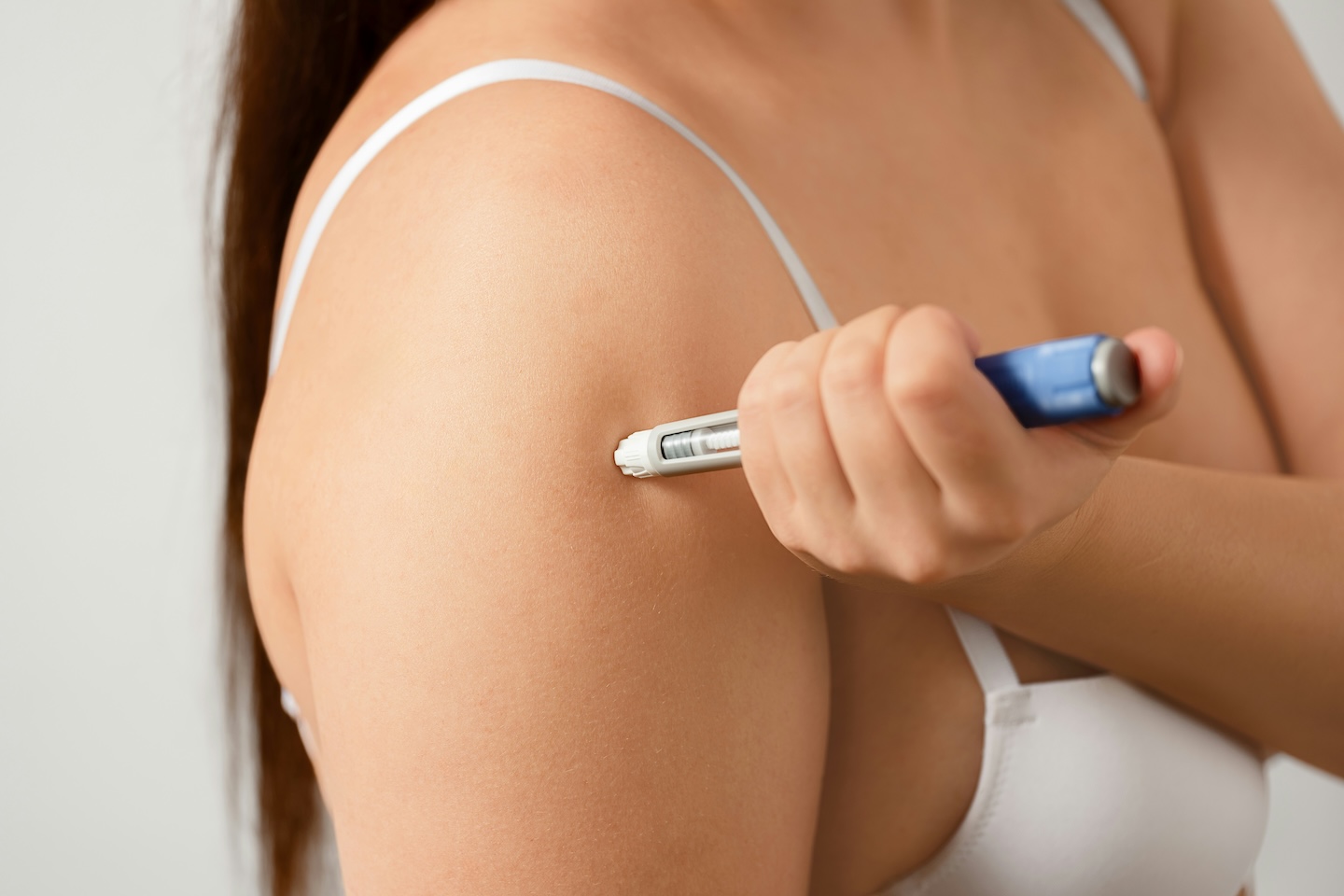
The 3 best sites for GLP-1 injections
The FDA has approved three spots on the body where tirzepatide and semaglutide injections are safe and effective: the abdomen, thigh, or upper arm. (Source: National Library of Medicine. https://www.ncbi.nlm.nih.gov/books/NBK603723/ ) These sites were selected based on the thickness and accessibility of subcutaneous fat, absorption consistency, and patient comfort during clinical trials.
Abdomen
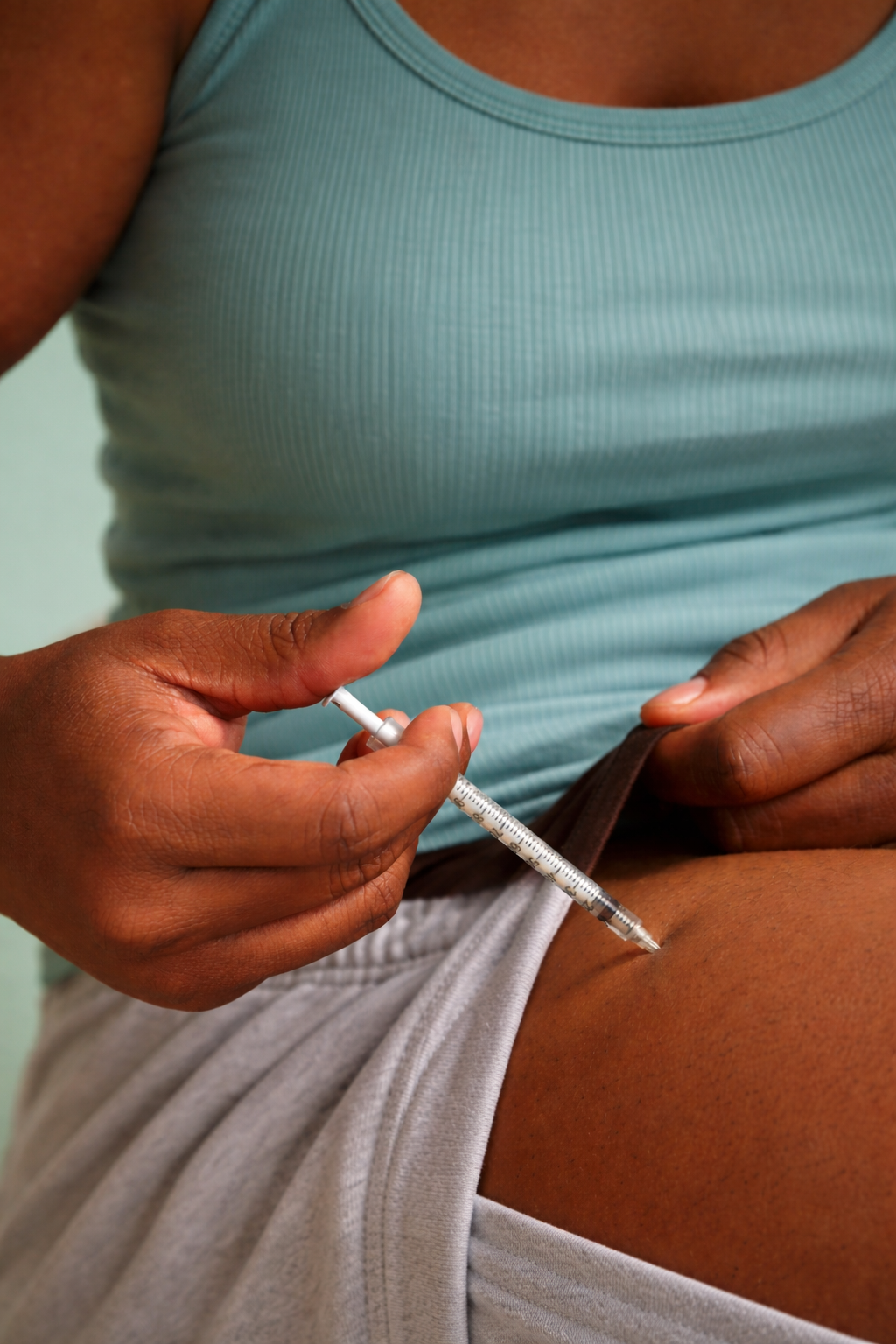
The abdomen is the most common GLP-1 injection site. This is the largest target zone and contains consistent subcutaneous fat for most people. Plus, it’s the easiest spot to get to if you’re doing the injection yourself.
Injections in the abdomen should be at least 2 inches from the belly button or surgical scars in any direction. The area around the navel has less fat under the skin, which can affect how well the medication is absorbed.
Thigh
The outer thigh, specifically the front outer portion between the knee and hip, is another popular injection site, especially for beginners and those with less belly fat. It’s easy to reach without assistance, still has a wide area to work with, and for some patients may be less sensitive than the abdomen.
If you have less subcutaneous fat on your thighs, you may need to use a 45-degree needle angle rather than the standard 90 degrees to ensure you are injecting into the fat rather than muscle. Your healthcare provider can guide you on the right angle for your body type.
Upper arm
The back-outer portion of the upper arm (the triceps area) is the third approved site. It’s often the least-used for self-injections since it can be tricky to inject correctly into your own arm, but it’s a convenient choice for those who prefer others to administer their dose for them.
If you do choose to self-inject in the upper arm, do it in front of a mirror and rest your arm against a steady surface (like a wall) before pinching the tissue and inserting the needle. Some patients find that upper arm injections are less painful than abdomen injections, so it’s worth trying to see how your body responds.
What is the best GLP-1 injection site?
There is no single best place to inject a GLP-1. As long as you’re injecting into one of the three approved sites—abdomen, thigh, upper arm—correctly, the drug should have the same effect.
Since one approved site won’t give you an advantage over the other, the best site is whichever is easiest and most comfortable for you. For instance, some patients find that they have fewer gastrointestinal side effects when they inject into the thigh instead of the abdomen, while others find that the upper arm is the least painful. Consider recording your experience with each site to help you determine which injection sites you prefer.
Why rotating injection sites is so important
Injection technique matters almost as much as the medication itself:
- Prevents lipohypertrophy: Repeated injections in the same spot can cause scar tissue to form, which cannot fully reverse on its own. Your best defense is to prevent lumps from forming in the first place.
- Reduces pain and bruising: Tissue that has been repeatedly injected becomes more sensitive. Rotating to fresh tissue makes each injection more comfortable and minimizes bruising and pain.
- Maintains consistent drug absorption: Injecting in the same spot week after week can affect how consistently the medication is absorbed. This also means you could experience more variability in appetite suppression, blood control, and side effects—not because your dose changed, but because absorption is erratic.
How to build a simple GLP-1 rotation schedule
The primary “rule” on rotating injection sites is to never inject within 1 inch of the previous injection. This leaves a lot of flexibility to find a rotation schedule that works for you. Here are a few ways you could build your schedule:
- Rotate across sites. For example, you could inject in the abdomen one week, a thigh the next, and upper arm the week after that.
- Divide each site into zones. The abdomen has 6–8 usable spots, each thigh has 4, and each arm has 2–3. So if you’d rather stick to the same general area each week, simply cycle through each “zone” in your preferred site.
- Keep a log. Remembering which day to inject is easy; remembering where you injected last week takes a bit more effort. To help you keep track, consider using a tracking app or notebook so you don’t risk injecting in the same site two weeks in a row by accident.
Some people find it helpful to pick a different spot in the same site each week, while others prefer rotating across all three sites. Both approaches work, as long as you’re not returning to the exact same location week after week.
Learn more: Step-by-step instructions for injecting a GLP-1
Common mistakes to avoid
Even experienced GLP-1 users can fall into habits that can reduce medication effectiveness or cause skin problems over time. Watch out for these common GLP-1 injection mistakes:
- Injecting in the same spot every week. By now you should know to avoid this, but it bears repeating. It’s easy to get complacent once you’re comfortable with injecting, but it’s still important to be diligent about rotating injection sites.
- Injecting into scar tissue, bruises, or irritated skin. These areas may not absorb medication as well. If you notice redness, firmness, or discoloration from a previous injection, skip that spot entirely until it heals.
- Injecting cold medication. Medication straight from the fridge is more likely to sting and may be more uncomfortable to inject. Let your pen or vial reach room temperature before using.
- Injecting into muscle. This is more likely to happen in leaner patients if they don’t pinch the skin.
- Rubbing the site after injection. Once you’ve removed the needle, you’re done. Rubbing the spot can cause local irritation and may affect absorption.
- Not logging your rotation. Without tracking, most people gradually drift back to the most comfortable spots, often the same location again and again, without realizing it.
Learn more: How to inject tirzepatide and semaglutide
When to talk to your provider
Most people don’t have trouble with injections, as long as they are following their provider’s instructions. However, if you notice any of the following, reach out to your provider:
- A firm lump, swelling, or visible bulge under the skin that doesn’t resolve within 1–2 weeks
- Persistent redness, warmth, or pain at the injection site
- Significant bruising that doesn’t resolve
- An unexplained change in how well your medication seems to be working, such as appetite changes or inconsistent blood sugar control
- Any signs of an allergic reaction, such as hives, swelling beyond the injection site, or difficulty breathing. Seek emergency care immediately in this case.
Frequently asked questions
Where is the best place to inject semaglutide or tirzepatide?
All three FDA-approved injection sites—abdomen, outer thigh, and upper arm—are equally effective. The best site is ultimately the one you can reach comfortably and consistently rotate within.
Can I inject GLP-1 medication into my arm by myself?
Yes, though it does require a bit more coordination than the abdomen or thigh. Try standing in front of a mirror and pressing your arm against a wall or countertop for stability. Many patients find it less uncomfortable than the abdomen once they’ve gotten the hang of it.
Does the injection site affect how well my GLP-1 medication works?
Absorption variation across injection sites is very minimal. What matters most is that you inject consistently and rotate injection sites regularly.
What is lipohypertrophy and how do I avoid it?
Lipohypertrophy is a buildup of thickened, scar-like fatty tissue caused by repeated injections in the same location. It feels like a firm lump under the skin and can impair medication absorption. Preventing lipohypertrophy by rotating injection sites regularly is the best line of defense. If you’re already noticing lumps, avoid those areas entirely and consult with your provider.
Are injection site reactions more common with tirzepatide or semaglutide?
A network meta-analysis of 19 randomized controlled trials involving more than 13,000 participants found that tirzepatide had a higher incidence of injection site reactions compared to semaglutide. (Source: National Library of Medicine, https://pmc.ncbi.nlm.nih.gov/articles/PMC12357579/ ) This makes regular rotation especially important for people using tirzepatide-based medications like Zepbound® and Mounjaro®.
What should I do if I see redness, bruising, or a lump at an injection site?
Mild redness immediately after injection is normal and usually resolves within 30–60 minutes. A small bruise is also common and is not concerning. However, if redness, swelling, or warmth persists for more than 72 hours, or if a firm lump develops and doesn’t resolve, contact your provider.
Can I inject into scar tissue or tattoos?
Avoid injecting into or immediately adjacent to scars. Scar tissue has altered structure that can impair drug absorption and may make injection more difficult or painful. Tattoos are generally safe to inject through in terms of ink, but the area may be more sensitive. Focus on rotating through areas with healthy, uncompromised subcutaneous fat rather than any fixed landmark.
This information is for educational purposes only and is not a substitute for medical advice. Please consult your healthcare provider before starting or changing any medication.
Compounded medications are prepared by licensed pharmacies to meet individual patient needs. While they are not reviewed or approved by the FDA for safety or effectiveness, they are made in accordance with strict regulatory guidelines. Prescription is only available after consultation with a licensed provider to determine if treatment is appropriate.